
A Commitment to Family Farms
Food Freedom
Food Freedom
North Carolina can remain a national agricultural leader, but only if we protect the economic viability of family farms, preserve farmland, and defend producers' freedom to make the choices that keep their farms sustainable and profitable.
Individuals should have the freedom to grow, raise, catch, and consume the food they choose without unnecessary red tape.
Globally, government restrictions on raw milk, seed saving, fishing industries, or direct farm-to-consumer sales are often framed as "safety" measures, but they also reduce individual and community self-sufficiency. Over the last two years, our own North Carolina leadership has tried to impose tighter flounder limits, new harvest reporting, and proposed shrimp-trawling bans, which have increased pressure on NC fishing families, threatening long-term family businesses and coastal independence.
The more dependent people are on regulated supply chains, the greater the state's control becomes in times of crisis.
Our dairy sector tells the story: in 2003, North Carolina had approximately 400 permitted dairy farms; by 2020, that number had decreased to around 138. I wonder how many dairy farms would remain profitable today if they were allowed to direct farm-to-consumer sales? NC State Extension Dairy Survey 2021
I will stand up for and with producers (both land and sea) who want to sell directly to consumers—strengthening local control and resisting overreach that pushes us away from the direct connection between the consumer and the producer. At the same time, I will fight for larger producers to have the freedom to choose diverse crops, access market data, and run their operations without bureaucratic interference. Whether it's a backyard coop or a thousand-acre row crop, every farmer deserves the freedom to feed North Carolina.
History proves that when a government limits a family's ability to feed itself, it's not about safety—it's about control. Food freedom is people's freedom.
Economy
Agricultural Economy
North Carolina's farm and agribusiness sectors are a powerhouse—contributing over $111 billion annually to our state's economy. NC Agriculture Economic Impact 2024
To build a more resilient agricultural economy, we need a clearer picture of where our value is generated and how it is reinvested. Family farms won't last if we don't treat them like businesses. The NC Department of Agriculture must provide producers the tools and information so they can make proactive decision-making based on forecasted profit margins.
That means the farmer analyzes expected yield, input costs, market price, crop insurance, land rent, fertilizer, seed, fuel, and labor before planting season to decide whether corn, soybeans, wheat, hay, or another crop has the best expected profit margin.
I support publishing detailed, sector-specific economic data that highlights profit centers, cost burdens, and downstream spending. This will inform smarter policy, enhance the return on investment for producers, and help retain more agricultural dollars in North Carolina communities. I would be interested in learning what percentage of the $111 billion remains in North Carolina.
The core policy issue is not simply whether agriculture is growing in total dollars. The issue is whether family farms can remain profitable, keep land in production, and remain free to serve local communities without being squeezed by rising costs, consolidation, and restrictive regulations.
We must expand value-added opportunities, keep land in production, and protect farmers from excessive regulation and rising development pressures.
Our agricultural policies must be transparent, consistent, and focused on real returns—supporting both small family farms and large-scale producers. When policy rewards productivity and reinvests in the people who work the land, rural communities grow stronger and the entire state benefits.
When we protect our land, reward our producers, and keep ag dollars local, North Carolina grows from the ground up.
2nd Amendment Rights
Defending the Second Amendment
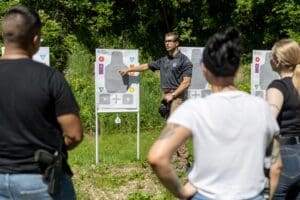
As a North Carolina-raised farm boy, holder of North Carolina Lifetime Sportsman hunting licenses, certified United States Concealed Carry Association (USCCA) Instructor, retired U.S. Army Colonel (over 33 years of service), and with two different combat tours, I fully support the constitutional right of every law-abiding citizen to keep and bear arms. I am tired of politicians treating responsible gun owners like criminals while doing nothing to stop actual crime.
The 2nd Amendment protects the people's right to be armed precisely so that a free people—not just a federal army—could secure their own liberty. I support concealed carry across state lines, oppose unconstitutional gun confiscation schemes, and reject federal overreach.
Over the first half of 2026, Virginia's Democratic trifecta advanced and signed major gun restrictions, including a future "assault firearms" sales ban, magazine limits, expanded background checks, under-21 purchase limits, and public-carry restrictions. This shows how quickly state-level control can become a national model for the Second Amendment.
Our Second Amendment is not up for negotiation—it protects our families, our freedom, and our way of life. Every time career politicians try to chip away at the Second Amendment, they remind us exactly why we need it.




Education
Education
As a Christian father and an experienced homeschool parent, I believe education should focus on real skills—not political agendas. We need to get back to the basics: reading, writing, math, and life skills like shop, home economics, and personal finance. Parents—not bureaucrats—should decide what's best for their children. That's why I support school choice, opportunity scholarships, and allowing families to direct their tax dollars to public, private, or homeschool education that aligns with their values and goals. Not every student needs college, but every student needs a future—and it starts with freedom in education.
Teach kids how to think, fix a truck, balance a checkbook—and let parents call the shots, not Raleigh.